
Cork’s rooflines tell a story. From the terraced houses of Sunday’s Well to the Georgian townhouses lining MacCurtain Street, the chimneys punctuating these rooftops are architectural signatures – distinctive, characterful, and quietly under siege from one of Ireland’s most punishing coastal climates.
The issue isn’t just the passing of time. It’s the unrelenting moisture from the Atlantic, building techniques from an era before modern standards, and well-intentioned repair efforts using inappropriate materials. From the street, a chimney might appear to be in good condition, but it could be concealing deteriorating mortar joints, a fractured crown, or a flue without a liner. These problems can quickly become hazardous and costly. Parnell Roofing & Building, a company specialising in chimney repairs throughout Cork, regularly come across these problems in homes that haven’t been professionally inspected in many years.
Whether you’re a proud new owner of a Victorian terrace in Montenotte or have been living in your period home for decades, knowing the top five chimney issues in Cork’s historic homes is the first step to safeguarding your property and its occupants.
Spalling is the process by which water infiltrates the surface of a brick, freezes, expands, and physically removes pieces of the brick. This freeze-thaw cycle affects chimneys in Cork more than almost any other part of a house due to the city’s consistent rainfall from the Atlantic and the chimney’s full exposure above the roofline without any protection.
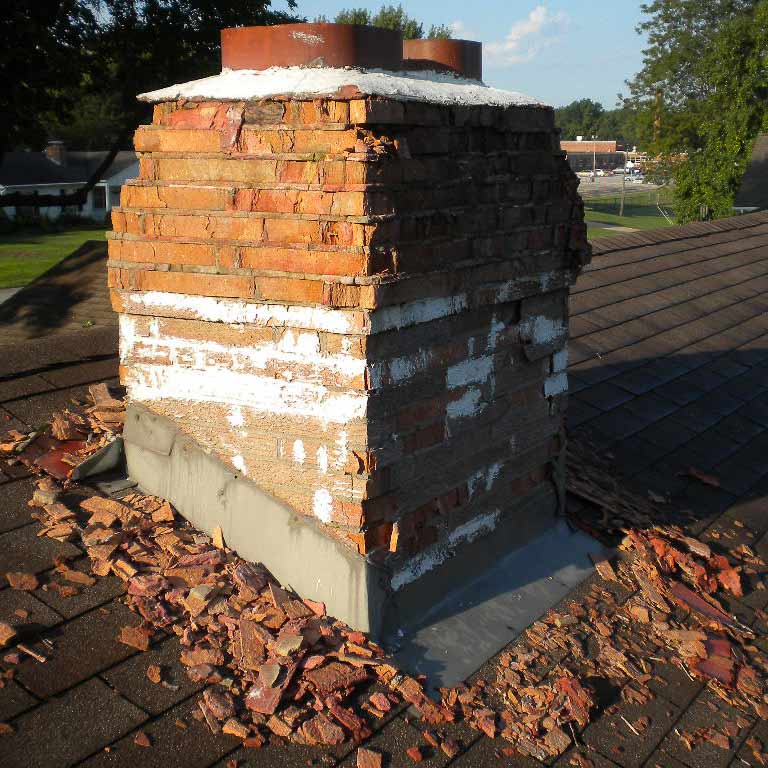
“What is a Spalling Brick Chimney …” from fullservicechimney.com and used with no modifications.
Located directly in the path of damp Atlantic weather systems, Cork city and county are particularly vulnerable to rainfall. The south and west-facing sides of chimneys bear the brunt of the damage, as wind-driven rain forces water into even the tiniest cracks in the brickwork. When the moisture penetrates the masonry and temperatures drop overnight – even in Ireland’s relatively mild winters – the expansion from freezing can cause structural damage that worsens with each passing year.
Historic Cork chimneys were constructed using soft, lime-based mortars and handmade bricks, which were intentionally quite porous. This porosity allowed the masonry to breathe and release moisture in a balanced manner. However, as these bricks age, develop micro-cracks, or are repointed with inappropriate modern cement-based mortar, the moisture balance is completely disrupted, leading to accelerated spalling. For homeowners in Cork, recognising signs of necessary roof inspections can help prevent further damage to these historic structures.
It’s difficult to see the early signs from the ground, but there are a few things to keep an eye out for:
Here are some signs you might need a chimney repair:
If you’re seeing any of these signs, it’s important to get a close inspection before the next winter season. What starts as surface spalling can progress to structural instability in the stack if left untreated through several more wet winters.
Tuckpointing, which involves removing damaged mortar to a depth of approximately 20mm and replacing it with fresh, correctly specified mortar, is the usual initial repair for spalling chimneys where the brickwork is mostly still in good condition. It is cost-effective and, when done with a lime-based mortar that matches the original mix, it can restore the chimney’s ability to properly manage moisture.
When the faces of bricks have spalled so deeply that it compromises the structural integrity of individual units, you have to replace the entire brick. This is especially important in historic homes in Cork, where it’s important to source matching handmade or reclaimed bricks. This isn’t just for aesthetics, but because mismatched brick hardness can create new stress points in the masonry. You can find out which route applies to your chimney with a professional assessment.
When you step into almost any Cork home constructed prior to 1920, there’s a high probability that the chimney is completely unlined. This wasn’t due to neglect – it just wasn’t the norm. The flue was simply the open space inside the chimney stack, with the exhaust gases passing straight through the raw brick and mortar on their way out.
During the Victorian and Edwardian periods, builders in Cork used thick masonry walls to control and direct heat. They believed that the thickness of the walls was sufficient for insulation and containment. This method was fairly effective for open coal fires that burned at fairly controlled temperatures. However, the problem arose when the mortar between the bricks began to deteriorate, which was bound to happen in Cork’s damp climate.
An unlined or damaged flue is a real fire and health risk. As the mortar joints deteriorate and break, openings appear in the flue wall. Combustion gases, including carbon monoxide, can leak through these openings into the wall cavity or directly into living areas. Creosote, a tar-like byproduct of burning wood or coal, also builds up much more aggressively on bare masonry than on a smooth liner surface, greatly increasing the risk of a chimney fire. For more information on maintaining your home, check out these signs you need a roof inspection.
Thankfully, installing a new liner doesn’t necessitate tearing down or visually changing your chimney. The three most feasible choices for Cork’s historic homes are:
None of these options affect the external appearance of your chimney stack in any way. From the street, the chimney looks exactly as it always has – but from a safety and performance standpoint, it’s been brought fully up to modern standards.
Keep in mind that if you’re putting a wood-burning stove into a chimney that previously had an open fire – a growing trend in Cork’s historic homes – a liner is a must. Irish building codes require it, and for good reason. Stoves burn hotter and more efficiently than open fires, creating flue gas temperatures that unlined historic masonry simply can’t withstand.
The most frequent chimney repair task in Cork’s historic homes is likely the repair of deteriorating mortar joints. This repair may seem straightforward, but the materials required are far from simple, leading to many missteps.

“Chimney Damage Caused By Moisture” from www.chimneysolutions.com and used with no modifications.
Repointing involves removing the damaged mortar from the joints, usually to a depth of 15–20mm, and replacing it with new mortar. This is a surface repair that deals with weathering and erosion without disturbing the deeper mortar that is still holding the masonry together. Full mortar replacement, on the other hand, requires taking apart sections of the chimney and completely rebuilding them, and is only necessary when the underlying mortar has completely failed throughout the stack.
Signs that suggest a job has moved from repointing to requiring a full replacement include:
In most cases, a chimney that’s been reasonably maintained will need repointing every 20–25 years in Cork’s climate. That timeline shortens considerably if previous repairs used the wrong type of mortar.
This is a classic example of a repair job with good intentions that ends in disaster. The modern Ordinary Portland Cement (OPC) mortar is much harder than the soft, handmade bricks that were used in the Victorian and Edwardian chimneys of Cork. When you apply a hard cement mortar to a soft, historic brick, the mortar is unable to flex with the natural movement of the masonry. This causes the stress to go directly into the bricks, which then leads to the bricks cracking and spalling from the inside out.
Historic masonry should always be repointed with a lime-based mortar, typically a hydraulic lime mix (NHL 2 or NHL 3.5 for exposed chimney locations) that matches the strength and flexibility of the original material. It costs a little more and takes longer to cure, but it works with the masonry rather than against it – and it will outlast a cement repoint by decades on a pre-1950s Cork chimney.
The chimney crown, a mortar or concrete slab, seals the top of the chimney stack and sits around the flue opening. It’s angled to shed rainwater away from the masonry below. The cap is directly over the flue opening. Together, they are the chimney’s first and most important line of defence against water. In historic Cork homes, they are often cracked, deteriorated, or completely missing.
Without a functioning crown, a chimney is basically a giant funnel that channels rain directly into the masonry and flue beneath it. In a place like Cork where it rains frequently, water collects in the flue each time it rains, soaking the surrounding bricks and gradually seeping down the stack into the house. This damage builds up silently over the years before it starts to show inside the house. If you suspect damage, it might be time to consider a roof inspection to prevent further issues.

“Expert Chimney Crown Repair …” from mastersservices.com and used with no modifications.
Water that seeps in through a broken chimney crown doesn’t just stay in the chimney. It soaks into the mortar joints in the stack, causing them to deteriorate more quickly. It travels down the inside of the flue, causing efflorescence – the white salt stains that appear on brick surfaces when moisture moves through them. In the worst cases, it can reach the chimney breast inside the house, causing damp patches, peeling plaster, and eventually structural damage to the wall itself. The cost of repairing all of this damage is much greater than the cost of fixing the crown in the first place.
When you have minor hairline cracking in a chimney crown that is otherwise in good shape, you can handle it with a flexible, waterproof crown sealant. Products such as ChimneySaver Crown Coat are made especially for this use, bridging small cracks and bringing back water resistance without having to completely rebuild. This is a cost-effective solution when the crown’s structure is still in good shape and the cracking is only on the surface.
If the crown is deeply cracked, has missing sections, or has been damaged over the years due to freeze-thaw cycles, the only lasting solution is a complete replacement. This involves removing all of the old crown material, fixing any damage to the masonry at the top of the chimney, and casting a new crown with a proper overhang and drip edge. These are details that are often overlooked in older or DIY repairs, but they make a big difference in how well the crown repels water over time.
Pyrolysis is the least-mentioned chimney problem on this list, but in Cork’s older homes – where coal fires were kept ablaze for years on end – it’s secretly responsible for some of the most severe structural damage discovered in historic chimneys. Unlike the other problems we’ve discussed, pyrolysis isn’t a result of weather or water damage. It’s caused by heat.
When brick is exposed to high temperatures over long periods of time, the carbon compounds within the brick begin to break down. This process is called chemical decomposition of organic material. The structure of the brick begins to break down at a molecular level, which causes it to lose density, strength, and cohesion. This damage isn’t always visible on the surface of the brick until it has become significant.
On a microscopic level, pyrolysis forces the clay minerals that make brick strong to recrystallize into weaker compounds. This makes the brick more and more brittle, and it loses its ability to withstand compressive loads. This is a big deal in a tall chimney stack, where the upper courses are bearing down on everything below. Bricks that have undergone a lot of pyrolysis will often look discoloured, becoming darker or reddish-brown, and they will feel lighter and more fragile than sound brick when you handle them.
Typically, the mortar surrounding bricks affected by pyrolysis is also in bad shape. This is due to the fact that the thermal cycling that causes pyrolysis also damages the bond between the mortar and the masonry. As a result, you have a chimney where both the bricks and the mortar that holds them together have been weakened at the same time. This makes it absolutely necessary to have a structural assessment done by a qualified professional before any repair work is started.
Heat damage, also known as pyrolysis damage, can be hard to spot. However, there are certain signs you can look for – especially in Cork homes where coal fires were the main source of heat for much of the 20th century:
If your chimney shows several of these signs together, a structural inspection is non-negotiable before the fireplace is used again. The risk isn’t just a repair bill – a structurally compromised chimney stack is a collapse hazard.
Coal burns at a much higher temperature than wood, and throughout most of the 20th century, it was the primary fuel source in homes in Cork. Many of these houses had their fires burning for the majority of the day during the winter months, year after year, for many years. This constant, repeated exposure to heat – far exceeding what the original masonry was built to withstand – is precisely the situation in which pyrolysis advances most rapidly.
If you live in a period home in Cork that used to burn coal and has since switched to gas or solid fuel stoves, the damage from the coal-burning years could still be present in the masonry. This is particularly true if your home was burning coal up until the mid-to-late 1900s and the chimney has never been professionally checked. Before you get any other repair work done, it’s worth looking into the possibility of pyrolysis damage.
All of the five problems discussed in this article start off as minor issues. A tiny crack in the crown. A small area of spalling on the upper stack. A little bit of mortar receding in the joints. None of these seem concerning on their own – but in Cork’s weather, with the Atlantic rain seeping into every crevice and winter temperatures expanding every crack, what’s insignificant in spring can become a major issue by fall.
In any historic home in Cork, the most economical way to maintain your chimney is simple: have a professional inspect it every two to three years, address any problems while they’re still at the repointing and sealing stage, and never use modern cement mortar on masonry that predates the 1950s. Following these three rules alone will save your chimney – and by extension, your home – from the sort of escalating damage that can turn a €300 repair into a €5,000 rebuild.
A chimney in a Cork historic home should be checked by a qualified professional every two to three years if the fireplace is frequently used, and at least every five years even if it isn’t. Cork’s Atlantic climate means that weather-related deterioration continues regardless of whether the chimney is being actively used – moisture, frost, and wind affect the masonry all year. An inspection doesn’t have to be costly; a visual check from a roofer familiar with historic masonry will identify potential issues before they become major problems. If you’ve just bought a period property and don’t have a record of the last inspection, make an immediate assessment a priority rather than a routine task.
While the process of repointing, which includes removing old mortar and applying new material, can technically be learned by a capable DIYer, it’s not as simple as it seems. The issues come when you try to repoint a chimney on a historic home in Cork. There are two main problems that most DIYers run into: safely working on a pitched roof at a height and choosing the right mortar specification. If you use Ordinary Portland Cement instead of a suitable hydraulic lime mix on soft historic brick, you’ll cause damage that accelerates over a few years and costs much more to repair than if you had hired a professional to repoint the chimney. Because chimneys are difficult to access and the materials are sensitive, it’s strongly recommended that you hire a professional.
The cost of chimney repair in Cork can vary greatly depending on the type and amount of work needed. Here are some general price ranges to give you an idea:
These figures reflect the Cork market and will fluctuate based on scaffolding requirements, the specific location of the property, and whether heritage-grade materials need to be sourced for a protected structure. Always get at least two written quotes for any chimney work, and be cautious of unusually low pricing – chimney repairs on historic homes require specific material knowledge, and cutting corners on specification creates far more expensive problems down the line.
Don’t forget to check if your property is eligible for grant support from the Built Heritage Investment Scheme (BHIS) or the Historic Structures Fund. Both of these can help offset the costs of repairs on protected or vernacular buildings in Cork. These schemes are administered yearly by Cork City Council and Cork County Council.
No – a chimney liner will not affect the external look of your chimney or home. The liner is fitted inside the existing flue void, concealed within the chimney stack. From the street, the roofline, or any external viewpoint, a lined chimney looks the same as an unlined one. This makes lining one of the simplest upgrades for Cork’s historic homes: it updates the chimney to current safety standards and building regulations without needing any changes to the stack’s profile, brickwork, or pots.
If you own a property that’s listed on the Record of Protected Structures (RPS) in Cork, you should check with the conservation officer at Cork City or County Council to make sure that the specific installation method proposed doesn’t require planning consent. However, in most cases, installing an internal liner on a domestic chimney is considered exempt development.
The answer to this question is usually not what homeowners want to hear, and it largely depends on the specifics of your policy. Most standard home insurance policies in Ireland cover sudden and unexpected damage, such as a chimney pot knocked over by a storm or structural damage caused by a severe weather event. However, gradual deterioration, including spalling caused by prolonged exposure to moisture and freeze-thaw cycles, is usually not covered because it is considered a maintenance issue rather than an insurable event.
What this means in practice is that if you wait until the chimney spalling is so severe that it causes visible damage to your property – at which point you might think you’d have a successful insurance claim – you’re likely to find that the cost of the underlying repair has multiplied several times over what it would have cost if you’d intervened early. Insurers may also query claims relating to deterioration if there’s evidence to suggest that the condition has been getting worse for some time and you’ve done nothing about it. For more information on when you might need to take action, check out 5 signs you need a roof inspection.
Chimney repairs in historic homes can present unique challenges. The age and architectural style of these homes often mean that traditional repair methods may not be suitable. It’s crucial to understand the common chimney problems that can arise in these aging structures to ensure proper maintenance and repair. Homeowners should consult with specialists like Parnell Roofing & Building who are experienced in dealing with the intricacies of older homes to preserve their historical integrity while ensuring safety and functionality.
Parnell Roofing – Trusted Roofers in Cork
Experts in roof repairs, replacements, and stormproof solutions across Cork. Fully insured, certified, and committed to quality workmanship.